

Maths at The Limes
At The Limes Primary Academy we feel passionately about developing children’s skills and fluency in maths at all stages. We aim to provide children with the fundamental skills required to gain confidence in maths and refine life long skills for high school and beyond. Above all else we want children to develop a love of mathematics at The Limes and tackle mathematical problems with accuracy, fluency, resilience and confidence.
My Mastery:

My Mastery is a structured program implemented at our primary school to ensure every child develops a strong foundation in core mathematical concepts. This approach moves beyond simply memorising facts, focusing instead on deep, conceptual understanding, problem-solving skills, and fluency with numbers.
The curriculum is designed in small, sequential steps, ensuring children master each concept thoroughly before moving on to the next. This "mastery" approach means that rather than accelerating advanced children to new content, they are challenged through depth, applying their knowledge in varied and complex scenarios. Support is also provided quickly to those who need it, ensuring no child falls behind.
Key components you can expect to see include:
- Concrete, Pictorial, Abstract (CPA) Approach: Children first grasp concepts using physical objects (concrete), then move to visual representations like drawings or diagrams (pictorial), before finally using standard numbers and symbols (abstract).
- Emphasis on Fluency and Reasoning: Regular practice builds speed and accuracy, while dedicated reasoning activities teach children how to explain how they reached an answer, fostering critical thinking.
- High Expectations: The program sets an expectation that all children can succeed in mathematics with the right support and mindset.
We encourage parents to reinforce these skills at home. Ask your child to explain their thinking behind their homework answers, practice times tables regularly, and look for opportunities to discuss math in everyday life, such as when cooking, shopping, or telling the time.
Times Table Rock Stars:

Times Table Rock Stars (TTRS) is a popular, engaging, and highly effective primary school programme designed to help children master their multiplication and division facts in a fun, interactive way. It is a core part of our mathematics curriculum aimed at boosting fluency and confidence in essential number skills.
How it Works
The programme transforms daily times table practice into a competitive and motivating rock-and-roll themed game.
- Customised Learning: Each child is given their own rock avatar, which they can customize as they earn coins through practice. The system tailors questions to the individual's needs, focusing on the facts they find most challenging.
Structured Progression: Children start as a "Wannabe" rock star and progress through different rock status levels (e.g., Gigger, Rock Star, Rock Legend) as their speed and accuracy improve.
Game Modes: TTRS features various modes, including:
Garage: The primary area where children
practice specific times tables set by their teacher. The platform intelligently focuses on the facts the child needs to work on most.
Studio: A fast-paced environment where children compete against the clock to answer random multiplication and division questions and improve their "Rock Speed" (average response time).
Gig/Arena: Opportunities for children to participate in whole-class or school-wide tournaments and battles, fostering a sense of community and friendly competition.
Why We Use It
Mastering multiplication and division facts is crucial for a child's mathematical development. It provides the foundation for more complex mathematical concepts like fractions, algebra, and problem-solving. TTRS makes this essential, sometimes challenging, practice enjoyable and rewarding.
How Parents Can Help at Home
We encourage parents to support their child's engagement with the program. Regular Practice: Just 5-10 minutes of daily practice can make a significant difference. Encourage your child to log in regularly using their secure school login details. Ask About Their Status: Show interest in their rock status and how many coins they have earned. This positive reinforcement motivates them to play more. Get Involved: You can compete against them in the "Arena" mode if you have your own account linked to their school (ask the class teacher for details).
For more detailed information, please visit the official Times Table Rock Stars website. If you have any further questions about your child's progress, please contact their class teacher.
Year 4 Multiplication Tables Check (MTC)
The Multiplication Tables Check (MTC) is a statutory assessment for all Year 4 children in state-funded English primary schools. Its purpose is to determine if children can fluently recall their multiplication facts up to 12 x 12. This skill is a crucial foundation for future success in mathematics, including work with fractions, division, and algebra.
What is the MTC?
The MTC is an on-screen, online check administered in June of Year 4.
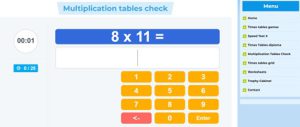
- Format: The check consists of 25 randomly generated questions on times tables from 2 to 12.
- Timing: Children have 6 seconds to answer each question, with a 3-second pause between questions.
- Duration: The entire check usually takes less than five minutes to complete.
- Scoring: The test is automatically scored by the system, and schools receive a total score out of 25 for each pupil.
Key Information for Parents
- No Pass Mark: There is no formal "pass" or "fail" mark for the MTC. The results are used by the school to identify any children who may need additional support with their times tables.
- Results: You will receive your child's individual score in their end-of-year school report.
- Accessibility: Access arrangements (such as a coloured screen background or a scribe) are available for children with special educational needs or disabilities (SEND) or English as an additional language (EAL) to ensure the check is accessible. These will be organised by the school if appropriate.
- Preparation: The school will prepare children for the check as part of their usual maths curriculum and practice. There is no need for additional external preparation, but regular, fun practice at home is beneficial.
How You Can Help at Home
Regular practice can build your child's confidence and fluency.
- Regular Practice: Encourage short, regular practice sessions (around 10 minutes a day) rather than long, intense ones.
- Use School Resources: We encourage children to use online games such as Times Tables Rock Stars to make practice engaging. The 'Soundcheck' mode on this platform is specifically designed to simulate the MTC format. We also recommend using the Timestables.co.uk website: Times tables games - Learn them all here! There is a practice MTC check which we use in school to practice as well as learning resources to support specific tables on the Times Table Diploma.
-
- Focus on Fluency: The goal is quick recall from memory (within 6 seconds) rather than counting the answers out.
- Keep it Positive: Ensure practice is stress-free. Building confidence is the main aim.
For more detailed information, you can read the official government guidance: Multiplication tables check: Multiplication tables check: information for parents - GOV.UK
If you have any questions or concerns about the MTC, please speak with your child's class teacher.
Maths in Year 6:
Year 6 Maths: A Guide for Parents

In Year 6, our children build on their knowledge and understanding of mathematical concepts as they prepare for the end of key stage 2 assessments (SATs) and transition to secondary school. We follow the White Rose Maths curriculum, a nationally recognized mastery approach designed to deepen understanding and ensure all children achieve their full potential.
The White Rose Approach
White Rose Maths uses a "small steps" approach, breaking down complex topics into manageable chunks. This methodology focuses on mastery, which means ensuring children have a deep, secure understanding of a concept before moving on. Key principles include:
Concrete, Pictorial, Abstract (CPA): Children use physical objects (concrete), move to drawings and diagrams (pictorial), and finally to formal equations and symbols (abstract).
Fluency, Reasoning, and Problem Solving: Lessons balance rapid recall of facts (fluency), explaining how they got an answer (reasoning), and applying skills to solve real-world problems.
Key Areas of Learning in Year 6
Throughout the year, your child will explore several key mathematical domains, revisiting and building upon them throughout the terms:
Number & Place Value Reading, writing, ordering, and comparing numbers up to 10 million; rounding numbers; negative numbers; identifying prime, square, and cube numbers.
Calculations: Mastering all four operations (addition, subtraction, multiplication, division) using formal written methods (e.g., long multiplication and long division); understanding the order of operations (BODMAS/PEMDAS).
Fractions, Decimals, & Percentages: Comparing, ordering, and calculating with fractions; multiplying and dividing fractions; understanding and using equivalences between fractions, decimals, and percentages.
Ratio & Proportion: Solving problems involving the relative sizes of two quantities, finding percentages of amounts, and scaling shapes.
Algebra: Introducing simple formulas; generating and describing linear number sequences; solving one-step and two-step equations.
Measurement: Converting between different units of metric and imperial measures (e.g., kilometres to miles); calculating the area of parallelograms and triangles; calculating the volume of cuboids.
Geometry: Drawing shapes using given dimensions and angles; finding unknown angles in various shapes and around a point; understanding coordinates and translation.
Statistics: Interpreting and constructing various graphs, including pie charts and line graphs, and calculating the mean average of a set of data.
How You Can Support Your Child at Home
The most effective way to support your child is by fostering a positive attitude towards maths and integrating it into everyday life. Practice Timetables: Fluent recall of all multiplication and division facts up to 12 x 12 is essential for success in Year 6 calculations. Involve them in real life Maths: Discuss money management, budgeting, reading train timetables, measuring ingredients for baking, or calculating the best deals when shopping. Talk About Maths: Ask your child to explain how they solved a problem, rather than just asking for the answer. This reinforces their reasoning skills. Encourage Problem Solving: Websites like the official White Rose Maths home learning hub offer free resources and practice activities that mirror classroom learning.